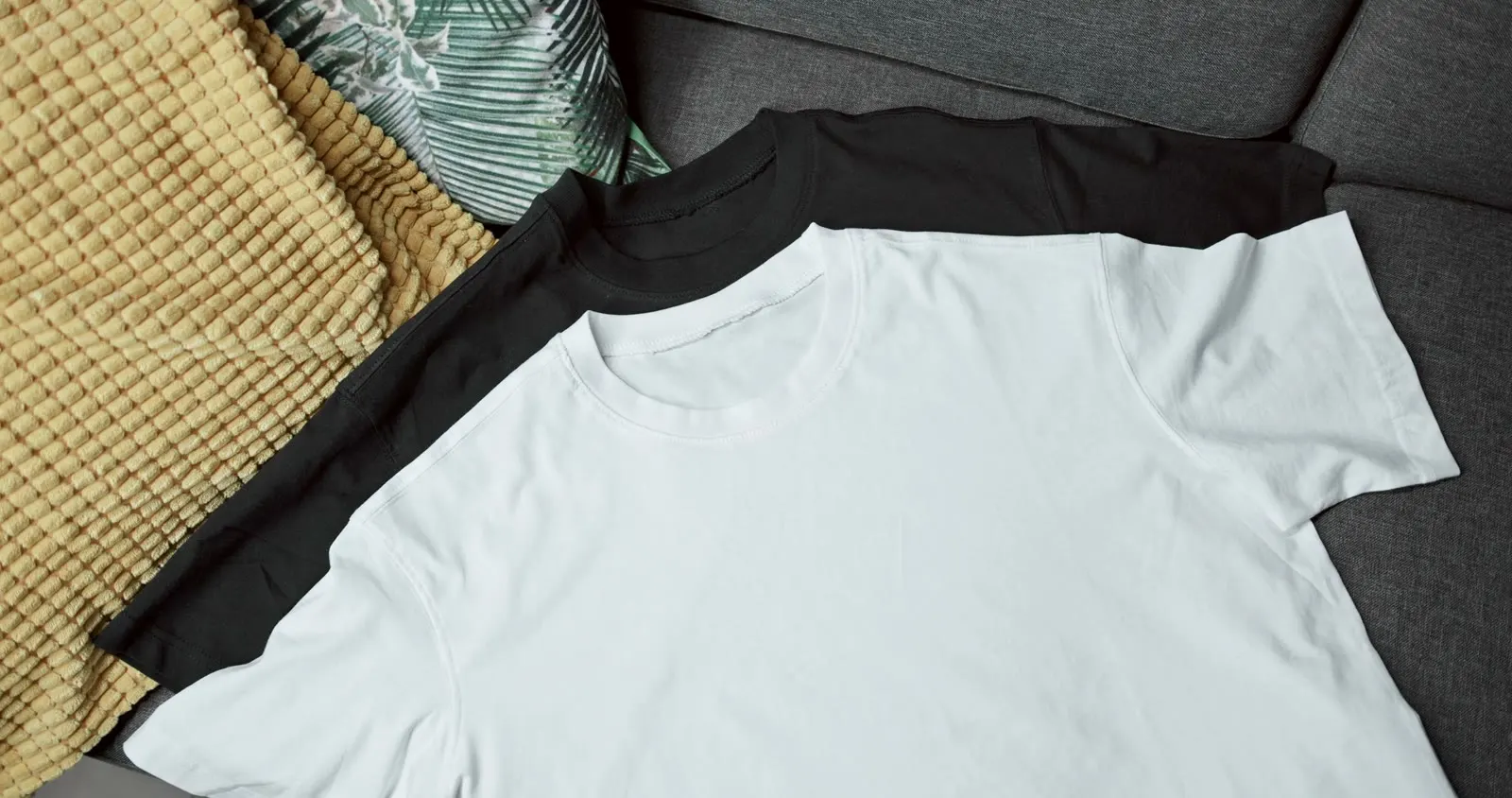
$8 vs $80 T-shirt: what the 100% cotton label leaves out
Short answer: A US clothing label must show the fibre, the country of origin and the maker, but not the fabric weight, so "100% cotton" leaves out most of what you pay for: weight (GSM), yarn quality, knitting and finishing. At the factory those differences cost a few dollars, not seventy: published Bangladeshi price lists show about $2.10–4.50 for a basic 180 GSM tee and $5.50–7.50 for a 220 GSM tee. The rest of a premium price is set after the factory, and no public source splits it.
Key figures
-
Not required
Fabric weight on a US clothing label (fibre content, origin and the maker's name or RN are required)
Edited Jan 2025 US Federal Trade Commission, Textile Act labelling guide
Link to this figure: Not required, Fabric weight on a US clothing label (fibre content, origin and the maker's name or RN are required) Link copied -
140–180 GSM
Fabric weight of everyday T-shirts, according to a Bangladeshi T-shirt maker; it puts heavyweight above roughly 220
Updated 3 Nov 2026 Collective Studio (Narayanganj)
Link to this figure: 140–180 GSM, Fabric weight of everyday T-shirts, according to a Bangladeshi T-shirt maker; it puts heavyweight above roughly 220 Link copied -
$2.10–3.80
Published FOB price of a basic 180 GSM cotton tee at 1,000 pieces ($2.50–4.50 at 300); an asking price, not a quote
Updated 23 Sep 2026 SDF (Bangladesh), pricing table
Link to this figure: $2.10–3.80, Published FOB price of a basic 180 GSM cotton tee at 1,000 pieces ($2.50–4.50 at 300); an asking price, not a quote Link copied -
$5.50
Published price of a 220 GSM tee at 500+ pieces ($7.50 at 30–99); no Incoterm stated
Updated 19 Nov 2026 TAT Clothing (Dhaka)
Link to this figure: $5.50, Published price of a 220 GSM tee at 500+ pieces ($7.50 at 30–99); no Incoterm stated Link copied -
$13 per kg
Average EU import price of cotton T-shirts from Bangladesh in 2025 (all countries: $16 per kg)
2025 (updated 21 May 2026) Public Eye
Link to this figure: $13 per kg, Average EU import price of cotton T-shirts from Bangladesh in 2025 (all countries: $16 per kg) Link copied
The trade-off: A heavier, combed, compacted tee costs more per piece, and heavier is not automatically better: weight is a style and comfort choice, and a light tee made from good yarn can outlast a heavy one made from coarse yarn. The factory prices here are published asking prices from a few makers, not quotes we received, and they change. Tight tolerances and lab tests add cost and can raise the chance of a bulk lot failing your spec, so agree them with the factory before the fabric is knitted.
Two plain T-shirts can both say “100% cotton”. Say one costs $8 and the other $80 (an illustrative example, not two real products). The label will not explain the gap. This guide covers what really differs, what it costs at a factory in Bangladesh, and how to write a spec you can compare quotes against. All prices are in US dollars.
What does a “100% cotton” label not tell you?
In the US, the Federal Trade Commission’s Textile Act guide says a clothing label must show fibre content, country of origin and the maker’s name or registered number (RN) (edited January 2025). Fabric weight is not on that list; extra information is allowed if it is not misleading. We have not checked UK or EU label rules here.
So the label names the fibre, not how much fabric there is or how it was spun, knitted and finished. Those decide how a tee feels, washes and lasts. For what a label can prove about origin, see how to check a “Made in Bangladesh” label.
What is GSM, and how do you measure it?
GSM means grams per square metre: the weight of one square metre of fabric. There is no official scale, so sellers draw their own lines:
- Collective Studio, a T-shirt maker in Narayanganj, says everyday tees are 140–180 GSM and heavyweight starts above roughly 220 (updated 3 November 2026).
- Printful, a print-on-demand company, puts lightweight at 120–150 GSM and medium at about 150–180 (January 2024).
- Texasia in Dhaka calls 220–260 GSM “heavy, structured” (checked October 2026). SDF calls 200–220 GSM premium heavyweight (updated 23 September 2026).
Heavier is not automatically better. One brand’s technical page says weight is a styling and comfort choice, not a quality guarantee (June 2026).
To check GSM yourself, cut a 10 × 10 cm square (0.01 m²) and multiply its weight in grams by 100. A 150 GSM square weighs only 1.5 g, so use a scale that reads to 0.01 g, not a kitchen scale. Laboratories use methods such as ASTM D3776 (reapproved 2025), which warns that a small swatch speaks for that swatch, not the whole lot.
What do combed, ring-spun and compact mean?
Cotton Incorporated, the US cotton industry’s research body, explains the yarn terms in a 2003 bulletin:
- Carded and combed. All cotton is carded: brushed to clean it and line the fibres up. Combed yarn has an extra step that removes short fibres, neps (small tangles) and trash, which can improve softness, strength and evenness.
- Ring-spun and open-end. These are spinning methods, not grades. Ring-spun yarn is the strongest, finest and softest, but the slowest and most expensive to make; open-end (rotor) yarn is cheaper but harsher and not as strong. Ring-spun does not mean combed: a yarn can be either.
- Compact. An add-on to ring spinning that gives greater strength and less hairiness.
Pills are the small balls of fibre on a worn tee. A 2015 Ege University study describes how rubbing pulls loose fibres to the surface, where they tangle into pills. Fewer short fibres mean fewer loose ends. Collective Studio says combed cotton is much less prone to pilling. Expect less pilling, not none.
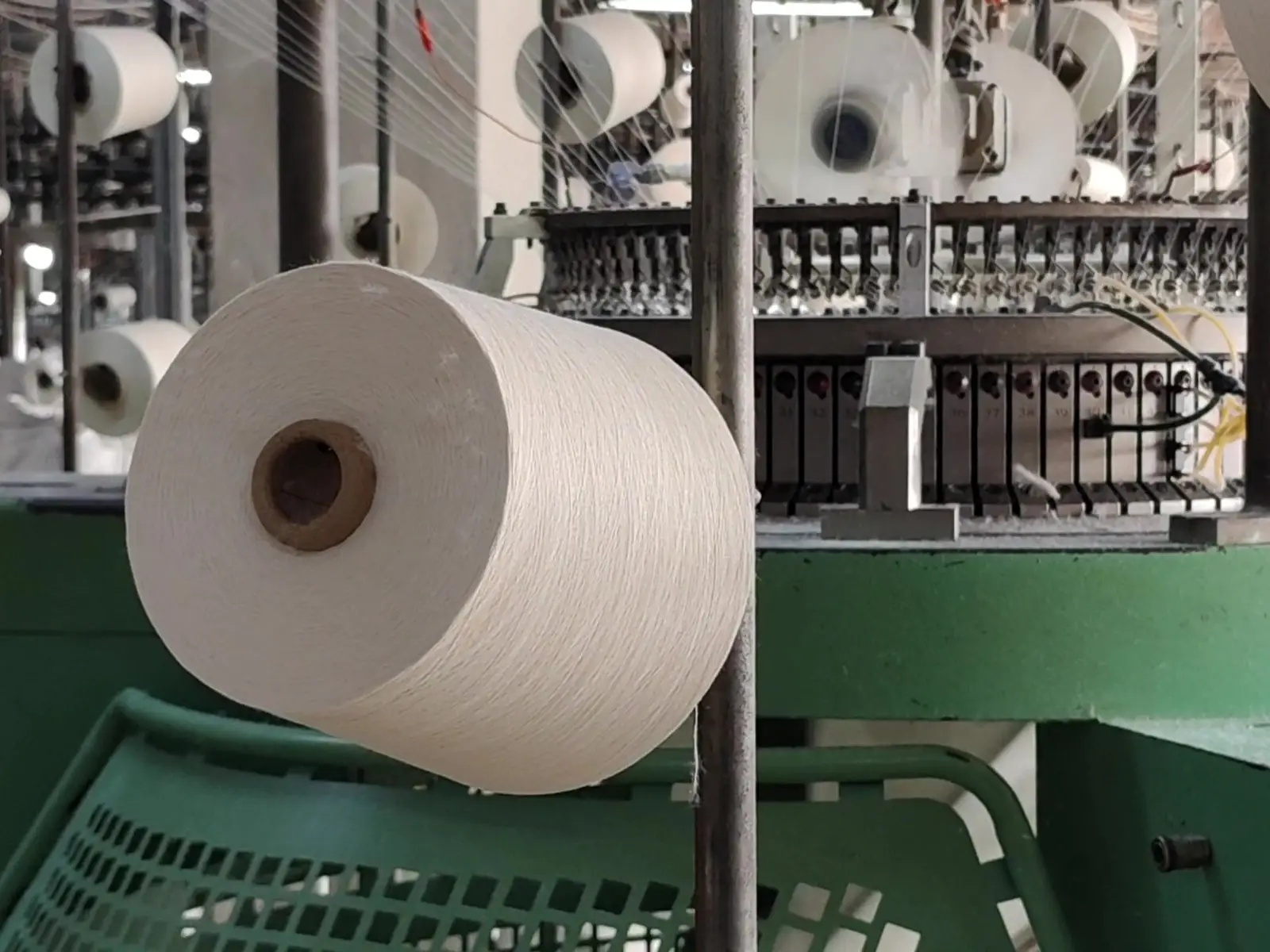
Yarn thickness is written as a count, such as 30/1 or 20/1. In the cotton system, a higher number means a finer yarn. SDF knits its 140–220 GSM tees on 30/1 and 20/1 yarn. Yarn count is not “thread count”.
How do knitting, dyeing and finishing change a T-shirt?
Most tees are single jersey, knitted as a tube, which Cotton Incorporated says skews as it relaxes, with the loops spiralling round the tube (2001). So some tees twist after washing. Collective Studio uses side seams as standard because tubular bodies twist.
Shrinkage is set in the knitting and finishing. Cotton Incorporated says cotton knits are very sensitive to forces in processing, and mills reduce shrinkage with relaxation drying and compaction, pressing the fabric together mechanically (2004). Collective Studio expects around 3–5% residual shrinkage on a well-finished cotton tee. That is one maker’s figure; set your own limit. Bio-polishing, an enzyme finish, removes small loose fibre ends from the surface.
TAT Clothing in Dhaka publishes this cost split for a typical $8.50, 250 GSM tee: undyed fabric 45%, dyeing and chemicals 20%, labour and making 20%, quality control and packing 10%, factory margin 5% (updated 19 November 2026). That is one factory’s example, not an industry average.
So where does the money go?
At the factory, a basic tee and a heavier one are a few dollars apart. These are published asking prices, not quotes we received:
- SDF: a 180 GSM tee at $2.10–3.80 for 1,000 pieces, or $2.50–4.50 for 300, FOB Chittagong (updated 23 September 2026). FOB (Free On Board) means the price covers making the goods and loading them onto the ship.
- TAT Clothing: a 220 GSM tee at $5.50 for 500+ pieces, or $7.50 for 30–99 (updated 19 November 2026). No Incoterm is stated.
- Texasia: quotes typically $2.50–8.50 FOB, rising with weight (checked October 2026).
By the kilo, the Swiss NGO Public Eye found the EU paid about $13 a kilo for cotton tees from Bangladesh in 2025, against $16 from all countries.
The rest of a premium price is set after the factory: freight, duty, the shop, marketing, unsold stock and margin. We found no public split of a premium tee’s shelf price, so we give none. An $80 tee is also not necessarily made in Bangladesh. For how a factory price becomes a landed cost, read why a T-shirt costs about $2 at the factory and the 300-hoodie example.
How do you specify a T-shirt so factories quote like for like?
Write the spec into your tech pack, the document that tells a factory exactly what to make. Quotes for different fabric cannot be compared.
| Item | Example | Why it matters |
|---|---|---|
| Finished weight | 180 GSM ±5% (an example; agree your own) | Weight drives yarn use and price |
| Yarn | 100% cotton, combed ring-spun, 30/1 | “Ring-spun” alone does not mean combed |
| Knit | Single jersey | Other knits cost and behave differently |
| Body | Side seams | Limits twisting after washing |
| Finishing | Compacted; enzyme finish if wanted | Controls shrinkage and surface fuzz |
| Shrinkage | Maximum 5% after washing, tested to AATCC TM135 | Stops a size disappearing in the first wash |
| Colour | Approved lab dip; ISO 105-C06 test | Checks the colour survives washing |
AATCC TM135 measures shrinkage after home laundering (2025 edition); ISO 105-C06 tests colour fastness to laundering. Ask for test reports, then check bulk against the approved sample: see how AQL inspection works.
Why it matters to buyers today
“100% cotton” tells you the fibre and little else. Weight, yarn, knit and finish make the difference, and at a Bangladeshi factory they add a few dollars, not seventy. The limit: these are asking prices from a few makers, and tighter specs and tests cost more. Get quotes against one written spec, and test the sample before you approve bulk. Loom & Harvest does factory checks, sample coordination and inspections for fixed fees; you can send an enquiry.
Common questions
Is a heavier T-shirt better quality?
Not automatically. GSM measures how much fabric there is, not how good the yarn or finishing is. One brand's technical page calls weight a styling and comfort choice, not a quality guarantee (Stanley/Stella, June 2026). Yarn type, knitting and finishing decide how a tee washes and wears.
What GSM is a heavyweight T-shirt?
There is no official line. Makers in Bangladesh start "heavyweight" at about 200–220 GSM (SDF, September 2026; Texasia and Collective Studio, October–November 2026), and everyday tees are about 140–180 GSM. Put the exact finished GSM and a tolerance in your tech pack instead of the word.
Is ring-spun the same as combed cotton?
No. Combing is a cleaning step that removes short fibres; ring spinning is a way of twisting fibre into yarn. A yarn can be carded ring-spun or combed ring-spun (Cotton Incorporated, 2003), so write both words in your spec if you want both.
How much more does a heavyweight tee cost at a factory in Bangladesh?
A few dollars, not tens of dollars. Published prices are $2.10–3.80 FOB for a 180 GSM tee at 1,000 pieces (SDF, September 2026) and $5.50 for a 220 GSM tee at 500+ pieces (TAT Clothing, November 2026). These are asking prices, not quotes, and small runs cost more.
Sources
This guide is correct as of . If a figure has changed since, tell us.
- US Federal Trade Commission, Threading Your Way Through the Labeling Requirements Under the Textile and Wool Acts (July 2014, edited January 2025) ftc.gov
- Collective Studio, T-shirt manufacturer in Bangladesh (published August 2026, updated 3 November 2026) collectivestudioltd.com GSM bands, combed and open-end yarn, compact yarn, side seams, residual shrinkage; a maker's own page
- Printful, heavyweight shirt guide (22 January 2024) printful.com Lightweight and medium-weight GSM bands
- Texasia, T-shirts (checked October 2026) texasia.com GSM options 140–260, 220–260 called heavy; quotes typically $2.50–8.50 FOB, rising with weight
- SDF, wholesale T-shirt supplier (updated 23 September 2026) sdfltd.com Pricing table FOB Chittagong 2025–2026; 140–220 GSM on 30/1 and 20/1 yarn; MOQ 300 per style
- TAT Clothing, tees, tanks, shorts and linen (27 May 2026, updated 19 November 2026) tatclothingco.com 220 GSM tee prices; cost split of a typical $8.50, 250 GSM tee; no Incoterm stated
- Stanley/Stella, T-shirts: why weight matters (1 June 2026) stanleystella.com
- ASTM D3776/D3776M-20(2025), mass per unit area (weight) of fabric store.astm.org
- Cotton Incorporated, ISP 1006 Cotton Spun Yarns for Knit and Woven Fabrics (2003) cottoninc.com Carding, combing, ring, open-end and compact spinning; yarn numbering
- Cotton Incorporated, TRI 2002 Knit Fabrics and the Reduction of Torque (2001) cottoninc.com
- Cotton Incorporated, ISP 1009 A Guide to Improved Shrinkage Performance of Cotton Fabrics (2004) cottoninc.com
- Dalbaşı and Özçelik Kayseri, anti-pilling treatments on cotton knitted fabrics, Tekstil ve Konfeksiyon 25(1), 2015 (Ege University) dergipark.org.tr
- Public Eye, 13 dollars for a kilo of T-shirts (updated 21 May 2026) publiceye.ch
- AATCC TM135-2025, dimensional changes of fabrics after home laundering members.aatcc.org
- ISO 105-C06:2010, colour fastness to domestic and commercial laundering (confirmed 2026) iso.org