Why a T-shirt from Bangladesh costs about $2 at the factory
Short answer: In 2025 the EU paid Bangladesh an average of $2.06 per cotton T-shirt, against $2.67 from all supplier countries. Three things explain the low price: very large scale, low wages and zero import duty in the UK, EU, Canada and Australia. But $2 is the factory price, not what the shirt costs you once it reaches your warehouse.
Key figures
-
$2.06
Link to this figure: $2.06, Average EU import price per cotton T-shirt from Bangladesh (all countries: $2.67)Average EU import price per cotton T-shirt from Bangladesh (all countries: $2.67)
Link copied -
$21.15 billion
Link to this figure: $21.15 billion, Bangladesh knitwear exports, July 2024 to June 2025Bangladesh knitwear exports, July 2024 to June 2025
FY2024-25 The Financial Express
Link copied -
Tk 12,500 (about $101)
Link to this figure: Tk 12,500 (about $101), Garment minimum wage per month before yearly increments, at Tk 123.16 per US dollar (11 Oct 2026)Garment minimum wage per month before yearly increments, at Tk 123.16 per US dollar (11 Oct 2026)
Oct 2026 The Business Standard; Bangladesh Bank
Link copied -
26.5%
Link to this figure: 26.5%, US duty on a cotton T-shirt from Bangladesh (16.5% normal rate plus 10% Section 301)US duty on a cotton T-shirt from Bangladesh (16.5% normal rate plus 10% Section 301)
Since 24 Jul 2026 TariffsTool
Link copied
The trade-off: The $2.06 is an average EU import price, not a quote for a small run, and it is not your landed cost: freight, inspection and any duty come on top. Duty-free access to the EU and UK is promised only to about the end of 2029, and Canada's transition is stated as intent.
Still pending
- Bangladesh's graduation from the UN Least Developed Country list is scheduled for 24 November 2026; its request to delay graduation to 2029 had no published UN decision as of 14 October 2026.
- Unions have asked for a new garment minimum wage of Tk 23,000-30,000; when last checked on 13 October 2026, the Tk 12,500 base rate (plus yearly increments) was still in force.
- Canada states its three-year post-graduation transition for duty-free access as government intent; our research found no formal order adopting it (checked 11 October 2026).
- The promised US zero-duty quota for Bangladeshi clothing made with US cotton had not been set up as of 25 September 2026.
A factory in Bangladesh can sell you a plain cotton T-shirt for about $2. All prices here are in US dollars. In 2025 the EU paid Bangladesh an average of $2.06 per cotton T-shirt. The average from all supplier countries was $2.67. Three things explain the gap: scale, wages and duty. But $2 is only where your costs start.
What does “$2” actually mean?
Factory prices are usually quoted FOB (Free On Board). FOB means the price covers making the goods and loading them onto the ship in Bangladesh. After that, freight, insurance, import duty and delivery are the buyer’s cost.
The $2.06 is an average EU import price across all shipments, not a quote. The same Financial Express report says standard cotton T-shirts trade at about $2–3 a piece, and that higher-paying brands rarely pay more than about $18 per kilo, roughly $3 a piece. Directory listings show plain cotton T-shirts mostly at $1.00–2.35 FOB. These are asking prices on a website, not checked quotes. A heavier fabric, a print or a small run will cost more per piece.
Reason 1: scale
Bangladesh makes basic knitwear in very large volumes. Knitwear exports alone earned $21.15 billion in FY2024-25, the year from July 2024 to June 2025. In 2025 Bangladesh also supplied 61% of the EU’s cotton T-shirt imports. Long runs of the same simple product keep the cost per piece low. For the wider picture, see why so much clothing is made in Bangladesh.
The trade-off: the system is built for volume. The minimum order quantity (MOQ) is the smallest order a factory will accept. One factory owner says most Bangladeshi firms typically require at least 500 pieces for a startup (2021). Because much of the fabric is bought in, the real minimum is often set by the fabric mill, not the sewing floor.
Reason 2: wages
The garment minimum wage is Tk 12,500 a month, set in December 2023, with yearly increments on top. At Bangladesh Bank’s rate of Tk 123.16 per US dollar on 11 October 2026, Tk 12,500 is about $101. Some guides, such as SourceReady, say $113 a month because they use an older exchange rate. For comparison, the 2026 legal minimum is about $140–200 in Vietnam and about $280–405 in China, depending on the area.
The trade-off: wages and other costs are rising. Unions have asked for a new wage board and a minimum of Tk 23,000–30,000; when last checked on 13 October 2026, the Tk 12,500 base rate was still in force. Diesel rose 17.4% in September 2026, and Chattogram port charges rose by an average of 41% from October 2025. Exporters say they cannot pass these costs on to buyers. In our reading, that squeeze raises the risk that a factory quietly cuts quality or moves work elsewhere.
Reason 3: zero duty in four big markets
Bangladesh is on the UN list of Least Developed Countries (LDCs), and many rich countries let LDC goods in duty-free. LDC graduation means leaving that list. The special access then usually continues for a transition period before it changes. Bangladesh is scheduled to graduate on 24 November 2026 and has asked to delay this to 2029. As of 14 October 2026, no UN decision had been published. Our guide to import duty by market sets out each market’s timeline.
| Cotton T-shirt from Bangladesh | Normal duty | Bangladesh pays | How long |
|---|---|---|---|
| UK | 12% | 0% | Unchanged for three years after graduation; the UK says garments stay duty-free after that |
| EU | 12% | 0% | To at least the end of 2029 |
| Canada | 18% | 0% | Three more years, stated as “intent” only |
| Australia | Not in our sources | 0% | Assurances given, no end date found |
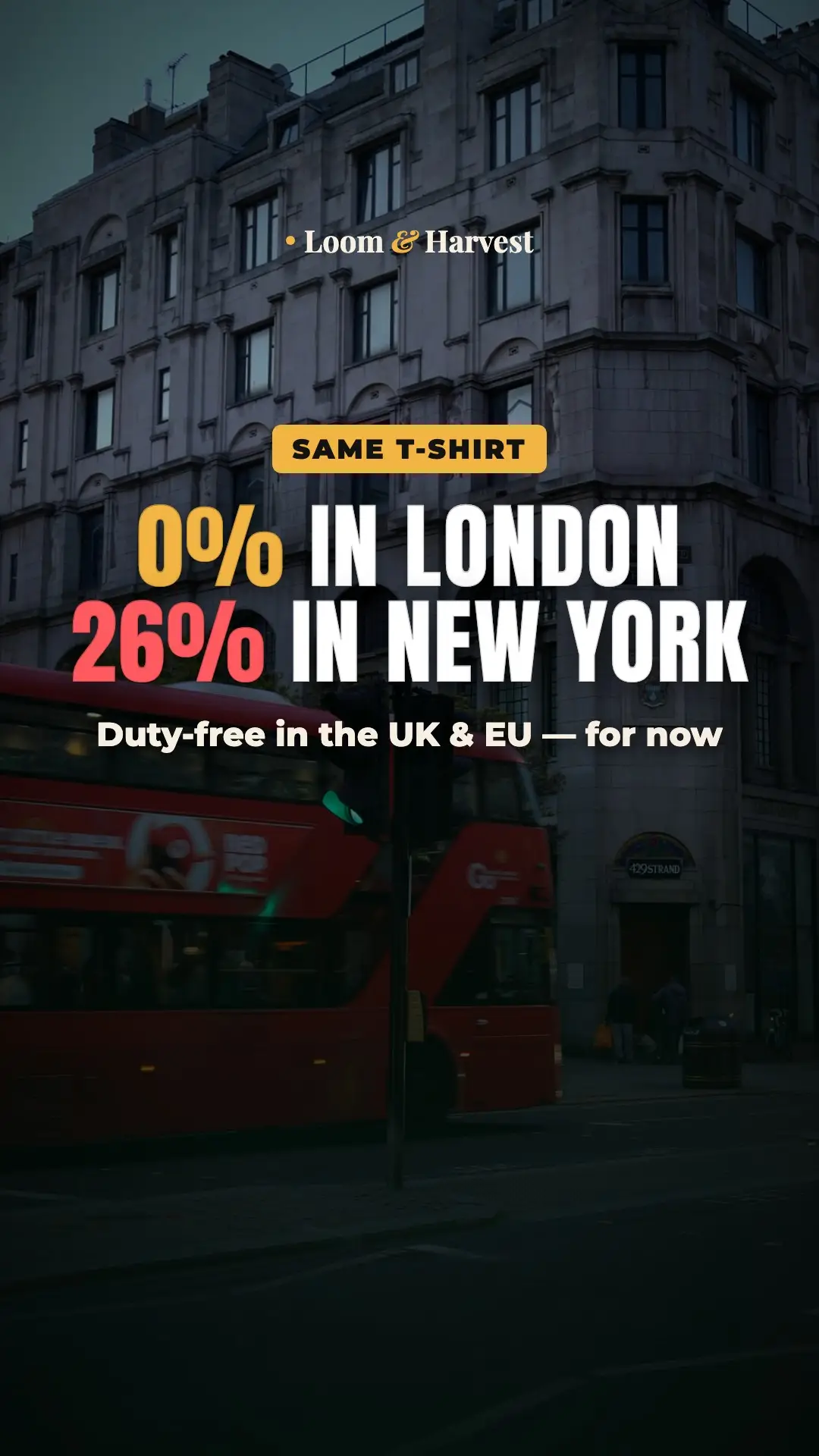
| US | 16.5% | About 26.5% | Extra 10% since 24 July 2026, no fixed end date |
The US figure includes a 10% duty under Section 301, a US trade law that lets the government add tariffs. This one covers 60 economies that, in the US view, have not banned imports made with forced labour. A promised US zero-duty quota for clothing made with US cotton had not been set up as of 25 September 2026.
The trade-off: this edge has a clock, and it needs paperwork. Zero duty applies only when the factory supplies the correct proof of origin. If Canada’s transition ends without a new scheme, Bangladeshi clothing could face about 17% average duty there (a 2022 law-firm estimate). Rivals are also gaining ground: India’s trade deal with the UK took effect on 15 July 2026.
Why is $2 not your final cost?
What you should compare is the landed cost: the full cost of getting goods to your warehouse, including the factory price, freight, insurance, import duty and fees. On top of the FOB price, budget for:
- Samples. Usually $20–50, often refunded with the bulk order.
- Freight. Sea is cheaper but slow; air is fast but costly. Ask a freight forwarder to quote for your actual cartons.
- Inspection. One inspection firm, V-Trust, publishes a rate of $268–298 per inspector-day in Bangladesh. One inspection of about $300 is 10% of a $3,000 order. See how an AQL inspection works.
- Duty and fees. Zero in the UK, EU, Canada and Australia with proof of origin; about 26.5% in the US, plus customs broker fees.
For a worked example, see what 300 hoodies from Bangladesh really cost to make and land.
What this means for your order
Ask each supplier for an FOB quote for your exact fabric, weight, print and quantity, then work out the landed cost for your market before you compare. Treat $2 as a benchmark for a basic shirt made in volume, not a price you should expect on a small first run. Loom & Harvest does factory checks, sample coordination and inspections for fixed fees; you can send us your product and quantity.
Common questions
Can I really buy T-shirts from Bangladesh for $2?
$2.06 was the EU's average import price in 2025, not a quote. Directory asking prices for plain cotton T-shirts are mostly $1.00 to $2.35 FOB, but heavier fabric, prints and small runs cost more, so get written quotes for your exact spec.
What is the difference between the FOB price and landed cost?
FOB covers making the goods and loading them onto the ship in Bangladesh. Landed cost adds freight, insurance, duty, inspection and fees, which is what the shirt really costs you at your warehouse.
Will Bangladesh stay duty-free after LDC graduation?
The EU keeps duty-free access to at least the end of 2029. The UK keeps it unchanged for three years after graduation and has said garments will stay duty-free under its scheme after that. Canada states a three-year transition as intent only. Graduation is scheduled for 24 November 2026, and a delay request was still undecided as of 14 October 2026.
Why is US duty so much higher?
The US gives Bangladesh no special access. A cotton T-shirt pays the normal 16.5% duty plus a 10% Section 301 duty in force since 24 July 2026, about 26.5% in total.
Sources
This guide is correct as of . If a figure has changed since, tell us.
- The Financial Express (EU T-shirt import study) thefinancialexpress.com.bd
- Fibre2Fashion (T-shirt supplier listings) fibre2fashion.com
- The Financial Express (FY2024-25 exports) thefinancialexpress.com.bd
- The Business Standard (small-order factory) tbsnews.net
- Apparel Resources (MOQ and fabric mills) apparelresources.com
- The Business Standard (garment minimum wage) tbsnews.net
- Bangladesh Bank (exchange rate) bb.org.bd
- Vietnam Briefing (minimum wage 2026) vietnam-briefing.com
- China Briefing (minimum wages) china-briefing.com
- The Financial Express (wage board demand) thefinancialexpress.com.bd
- The Business Standard (2026 fuel price rise) tbsnews.net
- Maritime Gateway (Chattogram port tariffs) maritimegateway.com
- The Daily Star (LDC graduation request) thedailystar.net
- UK Trade Tariff (cotton T-shirts, 6109 10) trade-tariff.service.gov.uk
- UK Trade Tariff, Northern Ireland (EU rates, 6109 10) trade-tariff.service.gov.uk
- Canada Border Services Agency (Customs Tariff 2026, chapter 61) cbsa-asfc.gc.ca
- The Daily Star (UK access after LDC graduation) thedailystar.net
- European Commission (EU GSP scheme from 2027) trade.ec.europa.eu
- Finance Canada (tariff preference programmes) canada.ca
- The Daily Star (Australia duty-free access) thedailystar.net
- TariffsTool (US clothing tariffs) tariffstool.com
- Greenberg Traurig (US Section 301 tariffs) gtlaw.com
- AirliftUSA (Bangladesh tariff tracker) airliftusa.com
- McMillan (Canada apparel duty) mcmillan.ca
- HLC (India-UK trade agreement) hlc.com
- SourceReady (sample costs) sourceready.com
- V-Trust (inspection rates in Bangladesh) eng.v-trust.com
- Global Sources (inspection cost on small orders) globalsources.com