Your T-shirt was probably made in Bangladesh. Here is why
Short answer: Bangladesh exported about $48 billion of goods in the year to June 2026, and about 80% of that was ready-made clothing. In 2025 it supplied 61% of the cotton T-shirts the EU imported. It is strongest in cotton basics and denim, but minimum orders are high, lead times are long and much of the fabric is imported.
Key figures
-
$48.0 billion
Link to this figure: $48.0 billion, Bangladesh's total goods exports, July 2025 to June 2026Bangladesh's total goods exports, July 2025 to June 2026
FY2025-26 The Financial Express (EPB data)
Link copied -
No. 2
Link to this figure: No. 2, Bangladesh's rank among world clothing exporters (6.76% share)Bangladesh's rank among world clothing exporters (6.76% share)
2025 The Business Standard (WTO data)
Link copied
The trade-off: Bangladesh is cheap and duty-free for the UK, EU, Canada and Australia, but it is built for volume: one factory owner says most firms want at least 500 pieces from a startup, much of the fabric is imported, and a 90-day delivery can stretch to 120-140 days.
Still pending
- Bangladesh's graduation from the UN Least Developed Country list is scheduled for 24 November 2026; its request to delay graduation to 2029 had no published UN decision as of 14 October 2026.
Look at the label inside a plain cotton T-shirt bought in London, Berlin or Toronto. It may well say “Made in Bangladesh”. Here is how big that trade is, what else Bangladesh sells, and where the limits are for a small brand.
How much of Bangladesh’s trade is clothing?
Bangladesh’s financial year runs from July to June, so “FY2025-26” means July 2025 to June 2026. In that year the country exported $48.0 billion of goods. Ready-made garments, often shortened to RMG, earned $38.70 billion of that, about 80%. RMG means finished clothing, not fabric or yarn. The figures come from Bangladesh’s Export Promotion Bureau (EPB).
The trade is huge, but it is not growing fast. Total exports fell 0.58% and garments fell 1.64% compared with FY2024-25.
Worldwide, Bangladesh was the second-largest clothing exporter in 2025, with 6.76% of world clothing exports, behind China. Vietnam was close behind at 6.53%.
Which clothes does Bangladesh make best?
Bangladesh is strongest in simple cotton products made in very large volumes:
- Cotton T-shirts. In 2025 Bangladesh supplied 61% of the cotton T-shirts the EU imported, at an average of $2.06 a shirt.
- Knitwear. Knitted clothing such as T-shirts, polos, sweatshirts and hoodies earned $21.15 billion in FY2024-25.
- Denim. In 2025 Bangladesh was the number one denim supplier to both the US and the EU.
It is weaker in synthetic and sports clothing. Cambodia and Vietnam took more of China’s lost clothing share than Bangladesh did, partly because Bangladesh has limited capacity in man-made fibres.
Who buys from Bangladesh, and why?
The US was the largest single market in FY2025-26, buying $9.05 billion of goods, followed by Germany and the UK. Canada imported $1.41 billion of clothing from Bangladesh in 2024, which made Bangladesh its third-largest supplier.
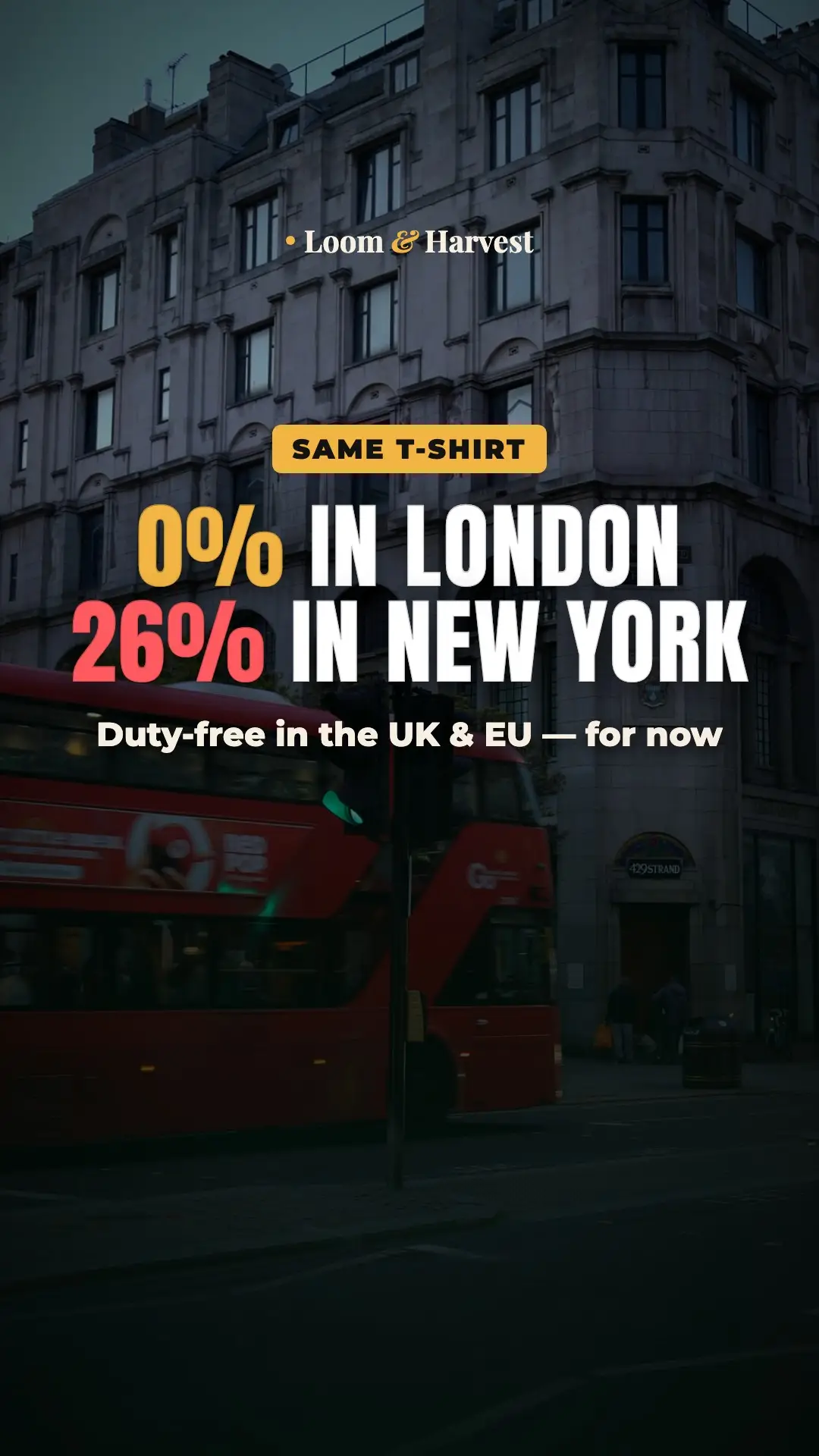
Price is one reason. Duty is another. Bangladesh is on the UN list of Least Developed Countries (LDCs), and the UK, the EU, Canada and Australia let almost all goods from Bangladesh in with zero import duty. The US does not. Since 24 July 2026, a cotton T-shirt from Bangladesh pays about 26.5% US duty. We explain price, wages and duty in detail in why a T-shirt from Bangladesh costs about $2.
That duty-free access has a date on it. Leaving the LDC list is called “LDC graduation”, and Bangladesh is scheduled to graduate on 24 November 2026. It has asked the UN to delay this to 2029. As of 14 October 2026, no decision had been published. Even after graduation, the EU keeps duty-free access to at least the end of 2029.
What else does Bangladesh export?
Clothing dominates. The other trades are much smaller, and some are shrinking. All figures are for FY2025-26.
| Product group | Export earnings | Change on the year before |
|---|---|---|
| Ready-made garments | $38.70 billion | −1.64% |
| Leather and leather products | $1.23 billion | +7.09% |
| Agricultural products | $975.39 million | −1.34% |
| Jute and jute goods | $883.69 million | +7.75% |
| Handicrafts | $32.13 million | −15% |
Mangoes, vegetables and spices make good stories, but agriculture is only about 2% of all exports. Bangladesh even imports about 90% of the spices it uses. Jute is Bangladesh’s own fibre, yet most of it still leaves as yarn, sacks and raw fibre rather than finished products. Our guide to jute exports explains that gap.
What are the catches for a small brand?
Each advantage comes with a limit:
- Imported inputs. Bangladesh imports much of its fabric and yarn from China and India. So the real minimum order is often set by the fabric mill, not the sewing floor.
- Minimum orders. The minimum order quantity (MOQ) is the smallest order a factory will accept. One factory owner says most Bangladeshi firms typically require at least 500 pieces for a startup (2021).
- Lead times. Customs, port and unrest problems can stretch a 90-day delivery to 120–140 days (2025).
- Energy. A gas shortage in July–August 2026 cut output by 70–90% in the Narsingdi textile cluster.
- Middlemen. One industry leader estimates that about 70% of factory orders go through buying houses (2025). Buying houses are local firms that place foreign orders with factories. The “factory” you find online may be one of them. Our five checks before paying a deposit show how to tell.
What this means for your order
If you sell cotton basics in the UK, the EU, Canada or Australia, Bangladesh belongs on your shortlist because of price and duty. Plan for minimums of around 500 pieces at mainstream factories, 90 to 140 days from order to delivery, and checks on who really makes your goods. Loom & Harvest does factory checks, sample coordination and inspections for fixed fees; you can tell us about your product.
Common questions
Is most of the world's clothing made in Bangladesh?
Not most, but a large share. Bangladesh was the world's second-largest clothing exporter in 2025, with 6.76% of world clothing exports, and it supplied 61% of the EU's cotton T-shirt imports that year.
What does Bangladesh export besides clothing?
In FY2025-26 it exported leather goods ($1.23 billion), agricultural products ($975.39 million), jute and jute goods ($883.69 million) and handicrafts ($32.13 million). All of these are small next to garments, which earned $38.70 billion.
Is clothing from Bangladesh duty-free?
Today almost all Bangladeshi goods enter the UK, the EU, Canada and Australia with zero duty, because Bangladesh is a Least Developed Country. In the US a cotton T-shirt pays about 26.5%. Graduation from the LDC list is scheduled for 24 November 2026, and a delay request was still undecided as of 14 October 2026.
Sources
This guide is correct as of . If a figure has changed since, tell us.
- The Financial Express (EPB export data, FY2025-26) thefinancialexpress.com.bd
- The Business Standard (FY2025-26 exports) tbsnews.net
- The Business Standard (WTO apparel export data, 2025) tbsnews.net
- The Financial Express (EU T-shirt import study) thefinancialexpress.com.bd
- The Financial Express (FY2024-25 exports) thefinancialexpress.com.bd
- The Daily Star (denim) thedailystar.net
- The Business Standard (RAPID analysis) tbsnews.net
- Fibre2Fashion (Canada apparel imports, 2024) fibre2fashion.com
- Greenberg Traurig (US Section 301 tariffs) gtlaw.com
- TariffsTool (US clothing tariffs) tariffstool.com
- The Daily Star (LDC graduation request) thedailystar.net
- European Commission (EU GSP scheme from 2027) trade.ec.europa.eu
- The Financial Express (agricultural exports) thefinancialexpress.com.bd
- The Financial Express (handicraft exports) thefinancialexpress.com.bd
- Dhaka Tribune (spice imports) dhakatribune.com
- The Business Standard (imported fabric and yarn) tbsnews.net
- Apparel Resources (MOQ and fabric mills) apparelresources.com
- The Business Standard (small-order factory) tbsnews.net
- Apparel Resources (buying houses and lead times) apparelresources.com
- Dhaka Tribune (2026 gas shortage) dhakatribune.com