Guides to sourcing from Bangladesh

Each guide expands one of our Shorts: prices, duty, factories, food rules and history, in plain English. Each one links its key figures to their sources and gives the date it is correct as of.

First order? Start here.

Read these three in order. Together they take about 16 minutes.

  1. How to import from Bangladesh: 7 steps for a first order

    The whole first order, from shortlist to customs, with a rough timeline for each step.

    5 min read

  2. What 300 hoodies from Bangladesh really cost to make and land

    One realistic order of 300 hoodies, costed line by line from the factory to the door.

    6 min read

  3. Real factory or middleman? 5 checks before you pay a deposit

    Five checks that show who you are really paying, before any deposit leaves your account.

    5 min read

Process

Finding and checking a factory, approving samples, paying safely and getting the goods home.

  • Real factory or middleman? 5 checks before you pay a deposit

    Before you pay a deposit, check five things: the trade licence and BGMEA or BKMEA membership, the factory's entry on the International Accord's public list, a live video walk-through, a bank account in the company's own name, and a written ban on hidden subcontracting. Middlemen are normal in Bangladesh, where one industry leader estimates that about 70% of factory orders go through buying houses. What matters is knowing who you pay and who actually sews your goods.
    Correct as of

  • How to import from Bangladesh: 7 steps for a first order

    A first order from Bangladesh follows seven steps: shortlist factories, ask for FOB prices, approve samples, sign and pay, production, pre-shipment inspection, then shipping and customs. Plan 4 to 7 months for a first order, not 2. Never skip the inspection, because it is your last good chance to fix problems while you still control the final payment.

    Correct as of

  • Perfect sample, bad bulk order: how to stop it with AQL inspection

    Samples are often made in a special sample room by the best workers, while bulk is made on the main floor, sometimes in another factory. The two fixes are a pre-shipment inspection using AQL sampling, and a contract that makes the final payment depend on a pass. In Bangladesh, one inspection firm publishes $268–298 per inspector-day.

    Correct as of

  • What is a buying house? Bangladesh sourcing explained

    A buying house is a local company that takes your order, places it with a factory, follows production and checks quality. About 70% of factory orders in Bangladesh come through one, according to a 2025 industry estimate. Agents usually charge 5–10% of order value, sometimes built into the unit price, so always ask who the factory is and what the fee is.

    Correct as of

Garments

What clothing from Bangladesh costs, who makes it, and what the label can and cannot tell you.

  • Your T-shirt was probably made in Bangladesh. Here is why

    Bangladesh exported about $48 billion of goods in the year to June 2026, and about 80% of that was ready-made clothing. In 2025 it supplied 61% of the cotton T-shirts the EU imported. It is strongest in cotton basics and denim, but minimum orders are high, lead times are long and much of the fabric is imported.

    Correct as of

  • Why a T-shirt from Bangladesh costs about $2 at the factory

    In 2025 the EU paid Bangladesh an average of $2.06 per cotton T-shirt, against $2.67 from all supplier countries. Three things explain the low price: very large scale, low wages and zero import duty in the UK, EU, Canada and Australia. But $2 is the factory price, not what the shirt costs you once it reaches your warehouse.

    Correct as of

  • Levi's 'Made in Bangladesh' label: real or fake, and how to check

    No, a 'Made in Bangladesh' label does not mean an item is fake. H&M, Primark, Uniqlo, Gap, Tommy Hilfiger, Calvin Klein and Levi's all make clothes there, and Bangladesh is the world's second-largest clothing exporter. But fakes also come from Bangladesh, so the label proves nothing either way: check the seller and the style number instead.

    Correct as of

  • What 300 hoodies from Bangladesh really cost to make and land

    Our October 2026 estimate for 300 printed fleece hoodies in one colour is about $10.50 each at the factory, with most published prices between $9 and $13. Shipped by sea, that comes to about £10.50 each landed in London, where duty is 0% with proof of origin, and about $17.70 in New York, where duty is 26.5%. These are estimates built from published price lists, not quotes.

    Correct as of

Duty & trade

Import duty by market, and how long duty-free access is confirmed.

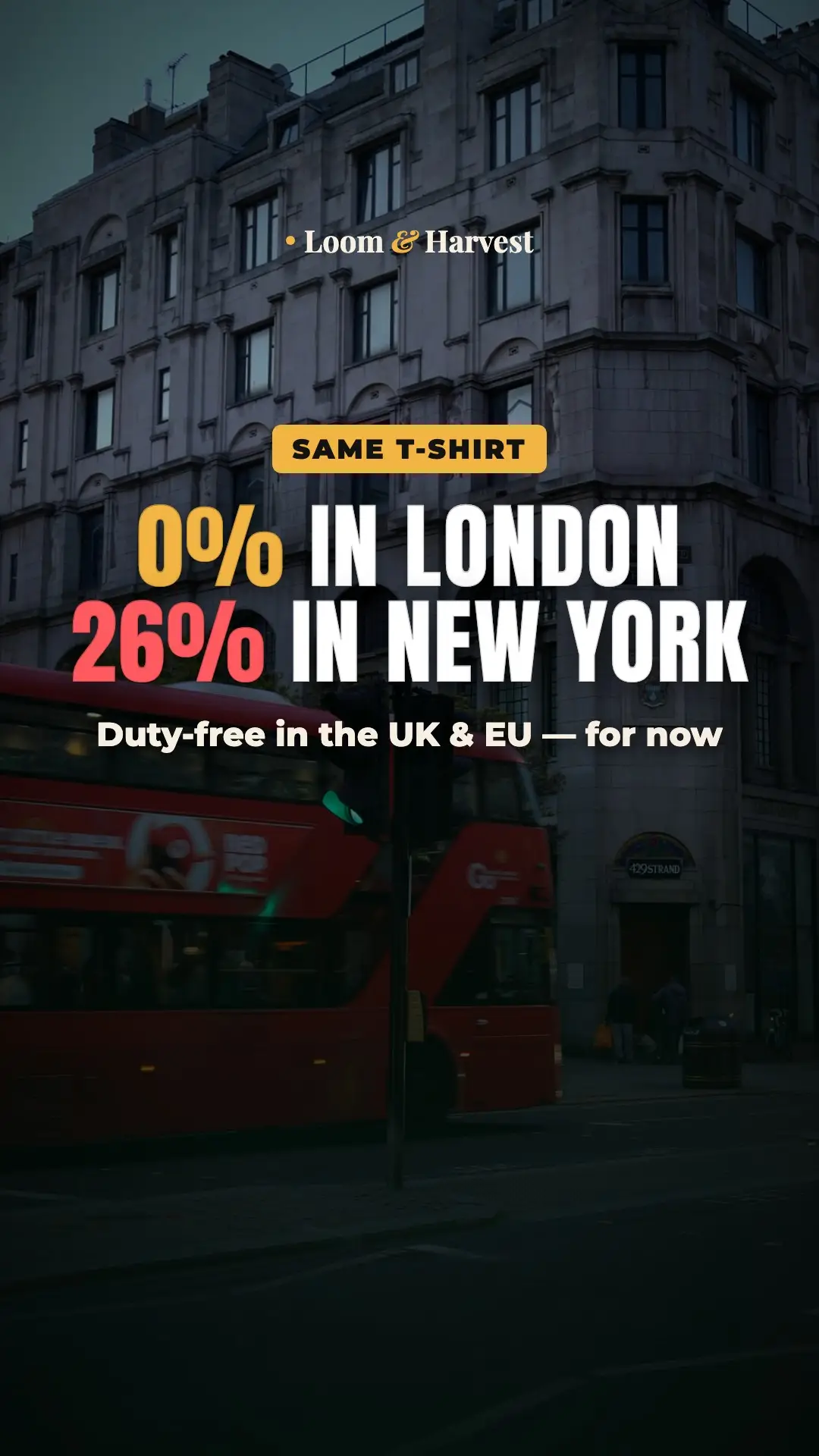
  • Bangladeshi T-shirt import duty: 0% in the UK, about 26.5% in the US

    Bangladesh is still a UN 'least developed country', so the UK, EU, Canada, Australia and Japan let almost all its goods in duty-free. Since 24 July 2026 the US has charged its normal duty plus an extra 10%, about 26.5% in total on a cotton T-shirt. The EU and UK keep duty-free access to at least the end of 2029; after that, the rules change.

    Correct as of

Jute

Bangladesh's own fibre, and the gap between jute yarn and finished bags.

  • Jute, Bangladesh's golden fibre, and the gap in finished goods

    Jute and jute goods earned Bangladesh about $884 million in the year to June 2026, up 7.75%. But most of it left as yarn, sacks and raw fibre: finished products such as tote bags, rugs and decor earned only $74.4 million, down 11.28%. That leaves room for custom-branded jute products, but the finished-goods trade is small and EU demand is weak.

    Correct as of

Food

Why Bangladeshi food is stopped at borders, what importers need first, and what drives the price.

  • Why some Bangladeshi foods get stopped at the US border

    The US Food and Drug Administration (FDA) names Bangladesh in 16 food-related import alerts. If a company is on an alert's red list, its shipments can be held at the border without examination until the importer proves they are safe. The main reasons are lead in turmeric, illegal food colours, Salmonella in spices, pesticides on vegetables and rice, and banned antibiotics in shrimp.

    Correct as of

  • Importing Bangladeshi food into Canada: what you need first

    To import food for sale into Canada you need a Safe Food for Canadians (SFC) licence from the CFIA, about C$300 for two years, before the shipment arrives. Customs entries without a valid licence number are automatically rejected. You also need a written preventive control plan, records that trace each lot, English and French labels, and DRC membership if you import fresh fruit or vegetables.

    Correct as of

  • Why Bangladeshi mangoes cost so much in London

    Bangladesh exports very few mangoes: about 2,194 tonnes in 2025, with the UK the largest buyer at 686 tonnes. The fruit has to fly, and air freight to London rose to nearly Tk 600 a kilo in 2026. No vapour-heat treatment plant, strict plant-health paperwork and middlemen who take much of the margin keep volumes small and prices high.

    Correct as of

History

How the export garment industry began, and the revival of Dhaka muslin.

  • How roughly 130 trainees started Bangladesh's garment industry

    In 1979 about 130 Bangladeshis with no garment experience trained for eight months at Daewoo's factory in Busan, South Korea, under a 1978 deal that paid Daewoo 8% of sales instead of any investment. They opened Desh Garments in Chittagong in 1980, then most left to set up and run other factories, and by 1985 Bangladesh had more than 700. Garments now earn the country nearly $40 billion a year.

    Correct as of

  • Dhaka muslin: the finger-ring legend and Bangladesh's revival

    Dhaka muslin was a famously fine handwoven cotton cloth that was lost for more than a century; the story that a whole sari could pass through a finger ring is a legend, not a measurement. Bangladesh began a revival in 2014, found a surviving cotton plant near Dhaka, and its finest yarn reaches about 731 metres per gram. The 58 pieces made in the first phase are kept for research and display, not sold.

    Correct as of