What a Bangladeshi garment worker earns for sewing a T-shirt
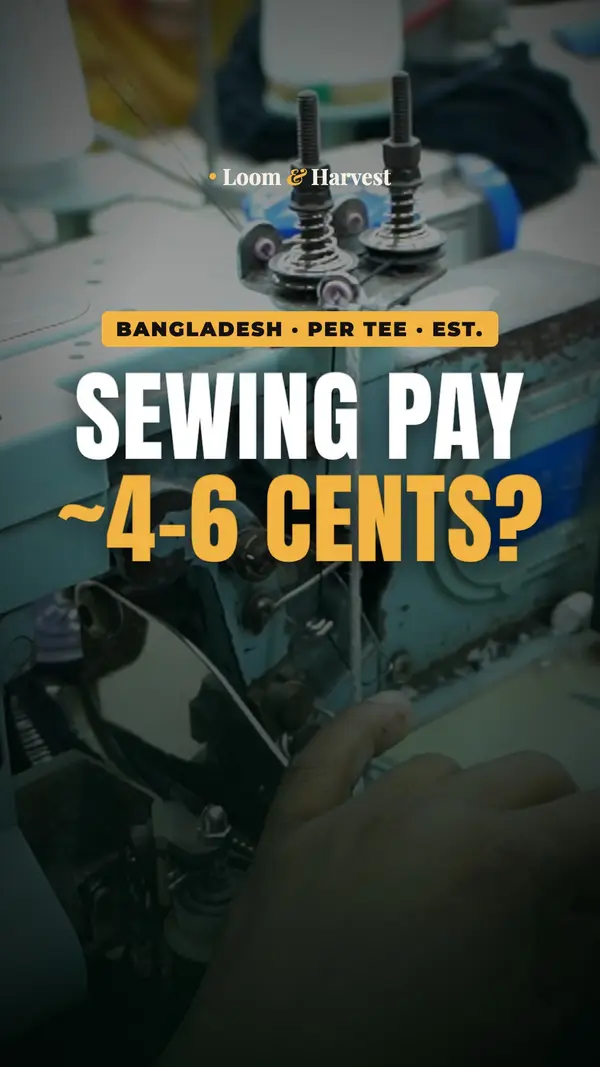
Short answer: The legal minimum for an entry-grade garment worker in Bangladesh is Tk 12,500 a month, about $100 or £76, in force since 1 December 2023, with yearly increments on top. A basic T-shirt takes about 5.4 standard minutes to sew, or 7.6 with checking, pressing and packing, so on paper the sewing pay in one shirt is about 4–6 US cents (our estimate). A new wage board is now setting a higher minimum, expected to apply from 1 December 2026.
Key figures
-
Tk 12,500
Monthly minimum gross wage for the entry grade (grade 4) of garment workers, in force since 1 December 2023
Dec 2023, still current Nov 2026 The Financial Express
Link to this figure: Tk 12,500, Monthly minimum gross wage for the entry grade (grade 4) of garment workers, in force since 1 December 2023 Link copied -
About $100 (£76)
Tk 12,500 at Bangladesh Bank's rates of Tk 124.75 per US dollar and about Tk 164.03 per pound
19 Nov 2026 Bangladesh Bank
Link to this figure: About $100 (£76), Tk 12,500 at Bangladesh Bank's rates of Tk 124.75 per US dollar and about Tk 164.03 per pound Link copied -
7.56 minutes
Standard time to sew, check, press and pack one crew-neck T-shirt (5.41 minutes of sewing alone)
2021 Online Clothing Study (operation bulletin)
Link to this figure: 7.56 minutes, Standard time to sew, check, press and pack one crew-neck T-shirt (5.41 minutes of sewing alone) Link copied -
About 4–6 US cents
Our estimate of the sewing and finishing pay in one basic T-shirt at the entry-grade minimum wage
Nov 2026 Loom & Harvest calculation (method in the guide)
Link to this figure: About 4–6 US cents, Our estimate of the sewing and finishing pay in one basic T-shirt at the entry-grade minimum wage Link copied -
Tk 32,000
Workers' representatives' proposed new monthly minimum, put to the wage board on 9 November 2026
9 Nov 2026 Prothom Alo
Link to this figure: Tk 32,000, Workers' representatives' proposed new monthly minimum, put to the wage board on 9 November 2026 Link copied
The trade-off: Low wages are one reason Bangladeshi basics are cheap, but that edge is under review. A new minimum is expected to apply from 1 December 2026, owners say buyers did not match past rises, and the per-shirt figures here are estimates for sewing labour only. Expect cut-and-make prices in 2027 quotes to change, and check that workers are paid the full legal rate.
Still pending
- The eighth Minimum Wage Board for garment workers, formed on 1 November 2026, had not set a new rate when checked on 22 November 2026. Workers proposed Tk 32,000; owners had not tabled a formal figure, and their proposal was due at a meeting on 23 November. Both sides agreed the new rate would apply from 1 December 2026, paid with January wages.
- Whether the extra 4% yearly increment added in December 2024 continues (9% in total) or falls back to 5% was disputed by unions and employers in October 2025; we found no later official ruling (checked 22 November 2026).
- Brands and global unions were preparing to renew the Bangladesh Safety Agreement (the Accord's Bangladesh programme) beyond 31 December 2026, according to an Accord statement of 24 April 2026; we found no confirmed renewal as of 22 November 2026.
A plain T-shirt made in Bangladesh carries only a few cents of sewing pay. That is our estimate, worked out below from the legal minimum wage and published sewing times. It is not what every worker earns, and it is not what the shirt costs to make. The minimum wage is also changing: a new wage board began work in November 2026.
What is the legal minimum wage, and what are the grades?
Bangladesh sets a separate minimum wage for garment workers. The current structure took effect on 1 December 2023 (The Financial Express, 20 December 2023). It has four grades:
| Grade | Monthly minimum (gross) |
|---|---|
| Grade 4 (entry level) | Tk 12,500 |
| Grade 3 | Tk 13,550 |
| Grade 2 | Tk 14,273 |
| Grade 1 | Tk 15,035 |
| Apprentice | Tk 9,875 |
“Gross” means the full monthly wage. For the entry grade it is a basic wage of Tk 6,700, plus house rent of Tk 3,350 and fixed allowances for medical care, transport and food.
On top of this come yearly increments: a fixed rise in pay after each year of service. The regular rate is 5%. In December 2024 the government added another 4%, making 9% (The Business Standard, 7 January 2025). By October 2025, unions and employers disagreed over whether the extra 4% continues. So many workers earn more than Tk 12,500. Labour representatives told The Daily Star that some workers earn Tk 19,000–20,000 a month, working 15–16 hours a day including overtime (21 October 2026).
What is that in dollars and pounds?
At Bangladesh Bank’s rate of Tk 124.75 per US dollar on 19 November 2026, Tk 12,500 is about $100 a month. At the bank’s pound rate of about Tk 164.03 on the same day, it is about £76. In October, at a slightly stronger taka, it was about $101, the figure in our T-shirt price guide.
The Labour Act sets a normal week of 48 hours (section 102). That is 48 × 52 ÷ 12 = 208 hours a month. So the entry wage is Tk 12,500 ÷ 208 = Tk 60 an hour, about 48 US cents or 37 pence (our calculation). Overtime is allowed up to 60 hours a week, and it must be paid at twice the basic wage (section 108). For the entry grade that is about Tk 64 an hour.
How much labour is in one T-shirt?
This is an estimate. Factories plan work in standard minutes (also called SMV or SAM): the time a trained operator needs for each step at a normal pace. A published operation bulletin for a crew-neck T-shirt by textile engineer Prasanta Sarkar lists 12 sewing steps totalling 5.41 minutes, and 7.56 minutes with quality checking, pressing and packing (Online Clothing Study, 2021).
Our method:
- Entry wage per minute: Tk 60.10 ÷ 60 = about Tk 1.00.
- Sewing only: 5.41 minutes × Tk 1.00 = Tk 5.42, about 4.3 cents (3.3p).
- Sewing, checking, pressing and packing: 7.56 minutes = Tk 7.57, about 6.1 cents (4.6p).
- The same bulletin plans the line at 80% efficiency. Real time is then 7.56 ÷ 0.8 = 9.45 minutes, about 7.6 cents (5.8p).
So, on paper, the sewing pay in a basic tee is about 4–6 cents, or nearer 8 cents at a realistic line speed. The limits: this leaves out cutting, supervisors, overtime pay, bonuses and higher grades. Sewing times also vary with fabric, design and the factory.
Why is the shirt price not mostly wages?
In 2025 the EU paid Bangladesh an average of $2.06 per cotton T-shirt. Our 4–6 cents is about 2–3% of that.
Most of a garment’s cost is material. In a 2019 costing of a polo shirt made in Bangladesh, the Fair Wear Foundation put fabric at $1.75 of a $3.50 factory cost. All labour, including allowances, was $0.54. Trims, embroidery, management and running costs made up the rest. That was a polo, before two wage rises, so use it for proportions, not prices.
This is why both sides argue about cents. The CPD think tank estimated in 2023 that seven cents more per garment could have covered its proposed wage. But a STITCH–BRAC University study found 67% of surveyed factories outside export zones got no price rise from buyers after the 2023 wage revision (both reported by The Daily Star, 21 October 2026).
What are workers and unions asking for now?
A recent change to the law moved the wage review from every five years to every three (The Business Standard, 15 October 2026). In October, workers protesting in Dhaka demanded around Tk 30,000 a month.
The government formed a six-member wage board, with owner, worker and independent members, on 1 November 2026. At its first meeting, both sides agreed the new rate would apply from 1 December, paid with January wages (BSS, 4 November). On 9 November, workers’ representatives proposed Tk 32,000 for the entry grade and Tk 30,000 for apprentices. That is about $257 or £195. Owners asked for more time. Before a meeting set for 16 November they reportedly discussed about Tk 14,000–15,000, but that meeting was postponed and they had not tabled a figure. The meeting was moved to 23 November.
At Tk 32,000, our same method gives about 11–16 cents of sewing pay per shirt (our estimate).
What can a brand check?
- Payslips and wage records. Ask the factory or an auditor to show a sample of payslips. Check the grade, the basic wage, the yearly increment and that nobody is below the legal minimum.
- Overtime. Compare time records with pay. Overtime should be paid at twice the basic rate, and total hours should stay within 60 a week.
- Audits. Ask for the latest social-compliance audit report, read the findings, and ask what was fixed.
- The Accord. The International Accord is a safety agreement between brands and unions. Check whether a factory is covered and whether its safety repairs are finished. See how to verify a factory.
- Your quote. Ask in writing how the new minimum wage will change the making charge, and from when.
Why it matters to buyers today
The wage in a basic T-shirt is a few cents, but it is about to rise, and factories say buyers have not always paid for past rises. A brand that plans for the new rate, and checks that it is paid, protects both its supply and its reputation. For how the industry got here, read the history of Bangladesh’s garment industry and where famous brands’ clothes are made. Loom & Harvest does factory checks, sample coordination and inspections for fixed fees; you can send an enquiry.
Common questions
Does every Bangladeshi garment worker earn Tk 12,500 a month?
No. Tk 12,500 is the legal minimum gross wage for the entry grade, set in 2023. Higher grades start at Tk 13,550 to Tk 15,035, yearly increments add to these, and overtime is paid at twice the basic rate. Apprentices can be paid Tk 9,875 for their first months (The Financial Express, 20 Dec 2023).
Is 4–6 cents what it costs to make a T-shirt?
No. It is our estimate of the sewing and finishing pay in one basic shirt at the entry-grade minimum, before cutting, line inefficiency, allowances, overheads and fabric. Fabric is usually the biggest cost. The EU paid an average of $2.06 per cotton T-shirt from Bangladesh in 2025.
When will the new minimum wage start?
The wage board's owner and worker members agreed on 4 November 2026 that the new rate will apply from 1 December 2026, paid with January wages (BSS). The amount had not been set when we checked on 22 November 2026.
Will a new minimum wage raise my factory price?
Probably, at least for the making charge, but by how much is not known yet. Labour is a small share of a basic shirt's price, so the rise per piece should be cents, not dollars. Ask each factory in writing how it will handle the new rate in your quote.
Sources
This guide is correct as of . If a figure has changed since, tell us.
- The Financial Express (2023 wage structure gazetted, 20 Dec 2023) thefinancialexpress.com.bd
- Dhaka Tribune (final wage grades, 26 Nov 2023) dhakatribune.com
- The Business Standard (9% yearly increment gazette, 7 Jan 2025) tbsnews.net
- The Financial Express (increment dispute, 28 Oct 2025) thefinancialexpress.com.bd
- Bangladesh Bank (exchange rates) bb.org.bd US dollar Tk 124.75 and pound cross rate Tk 164.01–164.05, effective 19 November 2026
- Bangladesh Labour Act 2006 (English text, sections 100, 102 and 108) bdlaws.minlaw.gov.bd
- Online Clothing Study (crew-neck T-shirt operation bulletin, 14 Aug 2021) onlineclothingstudy.com
- The Daily Star (Fair Wear Foundation polo-shirt costing, 11 Apr 2019) thedailystar.net
- The Financial Express (EU T-shirt import study) thefinancialexpress.com.bd
- The Business Standard (wage board nominations and three-year review, 15 Oct 2026) tbsnews.net
- The Daily Star (why wage unrest keeps returning, 21 Oct 2026) thedailystar.net
- Prothom Alo (wage board formed, 1 Nov 2026) en.prothomalo.com
- BSS (first wage board meeting, 4 Nov 2026) bssnews.net
- Prothom Alo (workers propose Tk 32,000, 9 Nov 2026) en.prothomalo.com
- The Financial Express (owners' proposal meeting postponed, 16 Nov 2026) thefinancialexpress.com.bd
- The Financial Express (revised wages in January, 17 Nov 2026) thefinancialexpress.com.bd
- International Accord (statement on Rana Plaza anniversary, 24 Apr 2026) internationalaccord.org