Jamdani: why one handwoven sharee can take six months
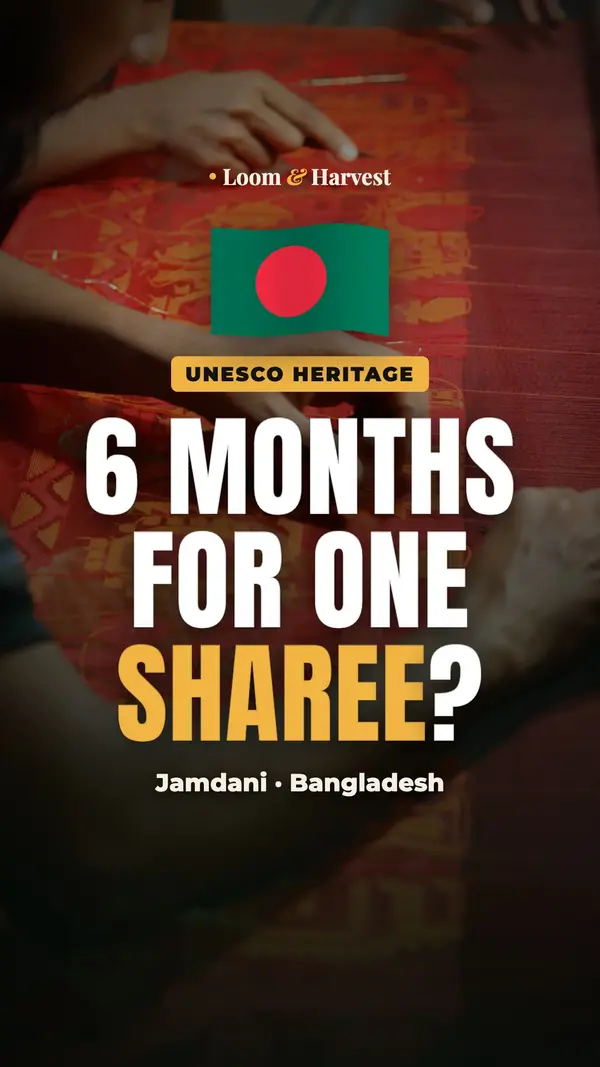
Short answer: Jamdani is a sheer handwoven cotton cloth from Bangladesh whose patterns are woven in by hand on the loom, not printed or embroidered. Because each motif is worked in by hand, one sharee can take from seven days to six months, The Business Standard reported in November 2024. UNESCO listed the craft in 2013, and it became Bangladesh's first GI product in 2016. Cheaper machine-made copies are sold under the same name, so ask who wove the cloth before you buy.
Key figures
-
7 days to 6 months
Time to weave one jamdani sharee, depending on the yarn, the motifs and the hours worked each day
Nov 2024 The Business Standard
Link to this figure: 7 days to 6 months, Time to weave one jamdani sharee, depending on the yarn, the motifs and the hours worked each day Link copied -
2013
Year UNESCO added the traditional art of jamdani weaving to its Representative List of the Intangible Cultural Heritage of Humanity
Dec 2013 UNESCO
Link to this figure: 2013, Year UNESCO added the traditional art of jamdani weaving to its Representative List of the Intangible Cultural Heritage of Humanity Link copied -
1st
Jamdani was the first product registered as a geographical indication (GI) in Bangladesh, in November 2016
Nov 2016 The Daily Star
Link to this figure: 1st, Jamdani was the first product registered as a geographical indication (GI) in Bangladesh, in November 2016 Link copied -
about 1,600
Weavers living at Jamdani Palli, the government weaving estate at Noapara, Rupganj
Feb 2023 The Daily Star, via Asia News Network
Link to this figure: about 1,600, Weavers living at Jamdani Palli, the government weaving estate at Noapara, Rupganj Link copied -
Tk 6,000 to Tk 100,000+
Reported retail price range for a handwoven cotton jamdani sharee in Bangladesh
Nov 2024 The Business Standard
Link to this figure: Tk 6,000 to Tk 100,000+, Reported retail price range for a handwoven cotton jamdani sharee in Bangladesh Link copied
The trade-off: Jamdani comes with unusually clear provenance: a UNESCO listing and a GI. But it is slow, made by hand in small workshops, varies from piece to piece and costs far more than machine-made copies that are sold under the same name. We found no official export figure for it, and a former government estate officer wrote in 2024 that low wages are pushing weavers out of the craft.
Jamdani is a fine, sheer cotton cloth woven by hand in Bangladesh. It is best known as the fabric of the sharee (also spelt sari or saree), the long draped garment worn by many Bengali women. UNESCO describes the work as “time-consuming and labour-intensive” (2013). This guide explains why, where it is made, and what a buyer should check.
What is jamdani, and how is it different from Dhaka muslin?
Jamdani is “a fine cloth of muslin group” with floral or geometric patterns (Banglapedia). According to UNESCO’s nomination file (2013), the Dhaka region once wove two kinds of muslin: plain and flowered. Plain muslin became extinct. The skills for flowered muslin survived, and that cloth became known as jamdani.
So jamdani is the patterned relative of Dhaka muslin, and the one that never stopped being made. Plain Dhaka muslin is a different story: a government project has been rebuilding it since 2014. Read how Bangladesh is reviving Dhaka muslin.
Why can one sharee take up to six months?
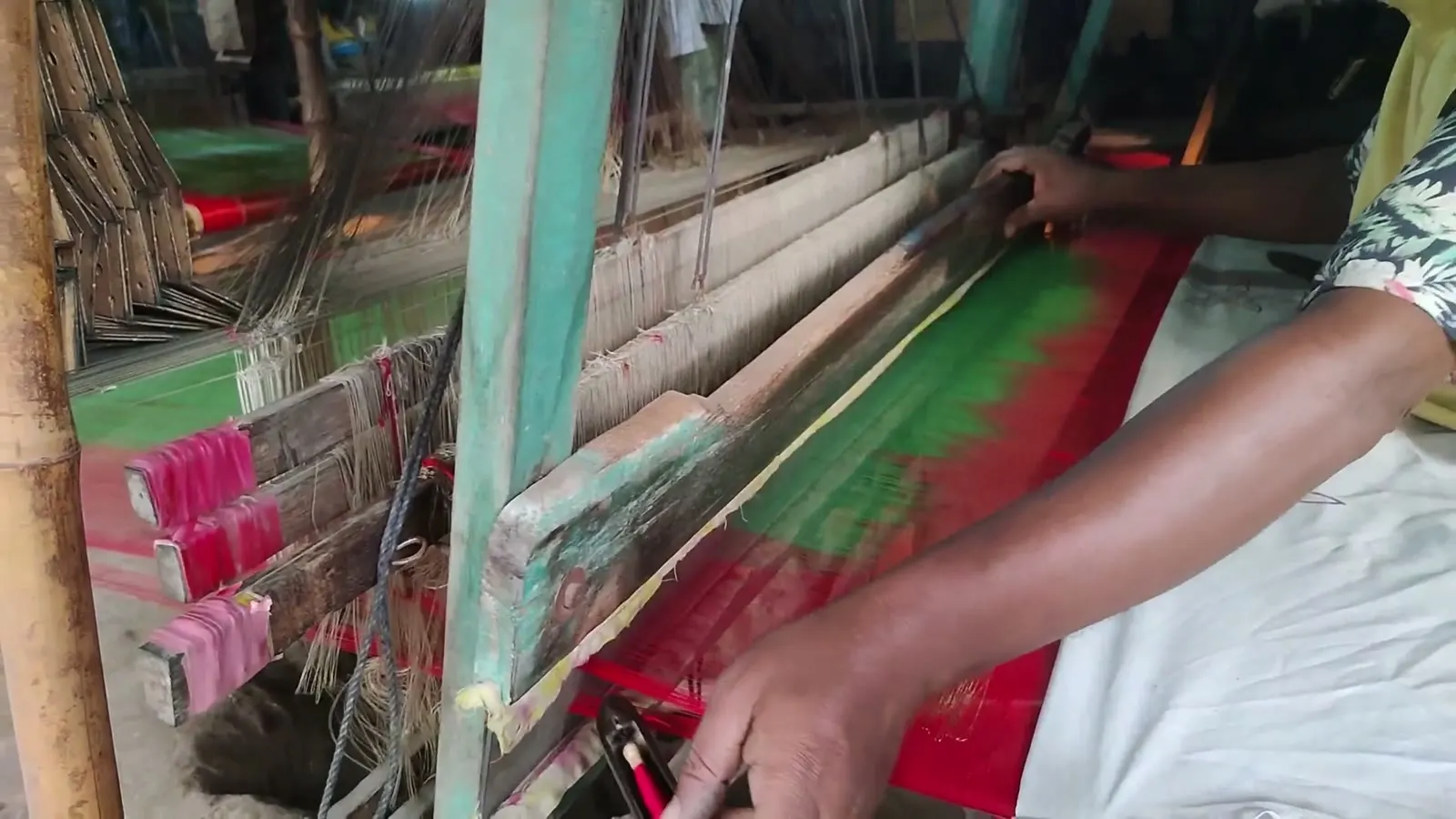
The patterns are not printed or embroidered. They are “created directly on the loom in the process of weaving” (UNESCO file, 2013).
Every woven cloth has two sets of threads. The warp runs along the length of the loom. The weft crosses it from side to side. In jamdani, the weavers add extra pattern threads by hand, only where a motif sits. UNESCO calls this the “discontinuous weft technique”. Each flower is built up row by row as the cloth grows.
Often two weavers sit side by side at one loom, and expert weavers do not need to draw the design on paper first (Banglapedia). The loom is built of wood and bamboo, with little metal (UNESCO file, 2013).
That is why making times vary so much. A sharee can take from seven days to six months, depending on the yarn, the motifs and the hours worked (The Business Standard, November 2024). Banglapedia puts a standard sharee at one to two months. For fine festival replicas, weavers told The Daily Star that each inch took almost eight hours (October 2019). One weaving-history platform founder told The Business Standard that weaving time, not thread count, is the main factor in price (2024).
Where is jamdani made?
Mostly in Narayanganj District, next to Dhaka. UNESCO’s file names Rupshi, Sonargaon and Siddhirganj as the centres. All three sit near the Shitalakshya River, which gives the humidity the fine yarn needs (2013).
The best-known site is Jamdani Palli, a weaving estate run by BSCIC, the state small-industries agency, at Noapara in Rupganj. BSCIC bought the land in 1993, and the estate has been fully operational since 2001, with 407 plots (The Daily Star, September 2024). About 1,600 weavers lived there in February 2023, and UNB counted 1,665 looms in April 2024.
What do the UNESCO listing and the GI mean?
In 2013 UNESCO added the traditional art of jamdani weaving to its Representative List of the Intangible Cultural Heritage of Humanity. The listing is about the skill and the community, not a quality mark on any one piece of cloth.
A geographical indication (GI) is a legal label that ties a product’s name to the place it comes from. Jamdani became Bangladesh’s first GI product in November 2016, after BSCIC applied on behalf of producers.
The limit: five years on, The Daily Star reported that jamdani was yet to reap the benefits of the GI tag. Weavers said they had no guidance on using it, and BSCIC had no figures for GI jamdani sales (August 2021). So a GI claim on a label tells you little on its own.
How can you tell handwoven jamdani from a machine copy?
Copies are common. Machine-made jamdanis, mostly from India, use the same motifs but lack the subtlety, cost much less and contain thicker threads (The Financial Express, December 2024). A Rupganj weaver told UNB that machine-made sarees are being sold as jamdani for about Tk 2,000, against at least Tk 5,000 for his own (April 2024).
Seller blogs offer tests, such as checking the back of the motifs, but they contradict each other, so we do not rely on them. Practical checks:
- Price. Handwoven cotton jamdani was reported at Tk 6,000 to over Tk 100,000 in Bangladesh (November 2024). These are reported shop prices, not checked quotes. A “jamdani” far below that range deserves questions.
- The maker. The Financial Express notes that authenticity depends on knowing the maker. Ask which weaver or workshop made it, and where.
- A sample in hand. Fine handwoven cloth looks and feels different from a thick-threaded copy, but only side by side.
The same logic applies to any product label; see how to check a “Made in Bangladesh” label.
Can you buy jamdani in quantity?
In small quantities, yes. Every Friday morning, traders gather at Jamdani Palli to buy sarees at wholesale prices (February 2023). Jamdani fabric is also used for kurtas, fatuas and salwar-kameez (BSS, March 2026), and a Chicago fashion label has sourced jamdani from Sonargaon for more than 10 years (The Daily Star, June 2023).
The limits are real. Each piece is slow to make and varies slightly. The same 2023 report said export shipments were “very low”, and a former estate officer wrote that low wages are pushing weavers out (September 2024). Agree the motif, yarn and tolerance for variation in writing, and approve a sample before you pay a deposit.
Why it matters to buyers today
Jamdani is a rare case of a Bangladeshi product with clear, documented roots: a UNESCO listing, a GI and a known weaving belt. That story can carry a premium product. But the name is copied, volumes are small and lead times are long, so the value depends on proving that your cloth is the real thing. Loom & Harvest does factory checks, sample coordination and inspections for fixed fees; you can send an enquiry.
Common questions
Is jamdani the same as Dhaka muslin?
They are related. UNESCO's 2013 nomination file says the Dhaka region wove two kinds of muslin, plain and flowered. Plain muslin died out; flowered muslin survived and became known as jamdani. Plain Dhaka muslin is now being revived by a separate government project.
How long does a jamdani sharee take to weave?
From seven days to six months, depending on the yarn, the motifs and the hours worked, The Business Standard reported in November 2024. Banglapedia puts a standard sharee at one to two months. The finest pieces can take longer.
How can I tell if jamdani is handwoven?
There is no single reliable test. Machine copies use thicker threads and cost much less (The Financial Express, December 2024). Online advice about checking the back of the cloth is contradictory. The safest check is knowing who wove it and where, and seeing a sample before you pay.
Can I order jamdani in bulk?
In small quantities, yes, but plan for long lead times and variation between pieces. Weavers at Jamdani Palli in Rupganj sell wholesale at a Friday market (The Daily Star, February 2023), and jamdani fabric is used for kurtas and other garments as well as sharees (BSS, March 2026).
Sources
This guide is correct as of . If a figure has changed since, tell us.
- UNESCO, Traditional art of Jamdani weaving (inscribed 2013, decision 8.COM 8.4) ich.unesco.org
- UNESCO nomination file No. 00879 (2013) ich.unesco.org
- The Business Standard, Know your Jamdani (15 November 2024) tbsnews.net
- Banglapedia, Jamdani en.banglapedia.org
- The Daily Star, Jamdani: a fabric of then and now (17 October 2019) thedailystar.net
- The Daily Star, Jamdani finally gets recognition (17 November 2016) thedailystar.net
- The Daily Star, No global gain yet for Jamdani (15 August 2021) thedailystar.net
- The Daily Star, via Asia News Network, Jamdani Palli: a village that weaves tradition (23 February 2023) asianews.network
- The Daily Star, Evolution of Jamdani and the role of BSCIC (22 September 2024) thedailystar.net
- UNB, Rupganj Jamdani weavers, traders eye Tk 150-160 cr Eid sale (1 April 2024) unb.com.bd
- The Financial Express, When threads meet time (18 December 2024) today.thefinancialexpress.com.bd
- The Daily Star, Jamdani shows promise in high-end global market (22 June 2023) thedailystar.net
- BSS, Jamdani a symbol of Bangladesh's glorious culture (10 March 2026) bssnews.net